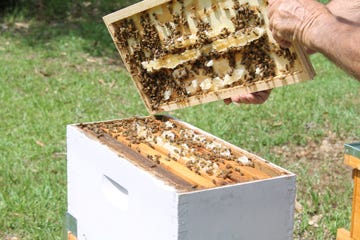

On a farm in Jay lives a U.S. mail carrier whose second business has proven far sweeter than his job. For the last 20 years, Chester Capers has produced honey, starting, he said, with a single colony after contacting an apiary he found delivering mail. Today, Capers said he cultivates 6 bee yards and 250 colonies. He also raises and sells queen bees for new and growing apiaries and produces bee keeping boxes and other supplies.
Capers said the last 3 to 4 years have been bad and he lost 30 to 40 colonies due unusually warm weather. He said his bees have to work hard flapping their wings to cool the hive; they need to keep it 75 to 90 degrees year round. However, the rainy seasons kept the problem from getting worse. Capers said the hive beetle, a notorious pest of the honey bee, was half as bad as last year because the additional rain washes away the beetle burrowed just under the surface of the ground. Capers created a solution for dealing with hive beetles by building a special trap fitting on the bottom of a honey bee box. He explained how the beetle will hide under the metal flap on the front of the box and fall into a tray below lined with lime, killing them. Capers said the trap is so popular he rarely has any on hand.
Capers may thrive as a honey producer, but he said the nation is experiencing a honey shortage. "The U.S. only furnishes 35 percent of U.S. honey," he said, saying the rest comes from China and other countries. Capers cited three reasons for reduced honey production in the country: a focus on pollination, pesticides, and logging. Capers said larger bee keepers are less concerned with producing honey and more with pollinating services for farmers' crops. Capers also said Monsanto Company insecticides are killing bees, a popular opinion among those concerned with Colony Collapse Disorder, the death of entire honey bee colonies due to bee disorientation. Finally, Capers said, "The way they cut timer now there is no place for wild bees." He said the vast majority of bees are domesticated. According to Capers, in the past the country was loaded with pines and oaks, a food source for bees. And the hollow logs, he said, left by downed trees, provided homes for hives. "If we don't keep honey bees going," Capers said, "we'll have a shortage on squash, cucumbers, apple trees and orange trees." According to the National Resources Defense Council, roughly a third of world crops rely on cross-pollination by bees. Capers said he tries to put bees in wooded areas. He has popcorn and Formosa trees and expects young pines by the summer. "If people help take care of timber, the bees will do better," he said.
The alternative health industry, Capers said, has given the honey industry a boost. Honey is good for cuts and burns externally, he said, and excellent with vinegar for cleaning the system internally, also a good source of protein. Capers said since honey is already digested it goes straight into the blood stream. "Honey is pure, good, 100 percent medicine," he said.
This article originally appeared on Santa Rosa Press Gazette: Rebuilding America's sweet medicine