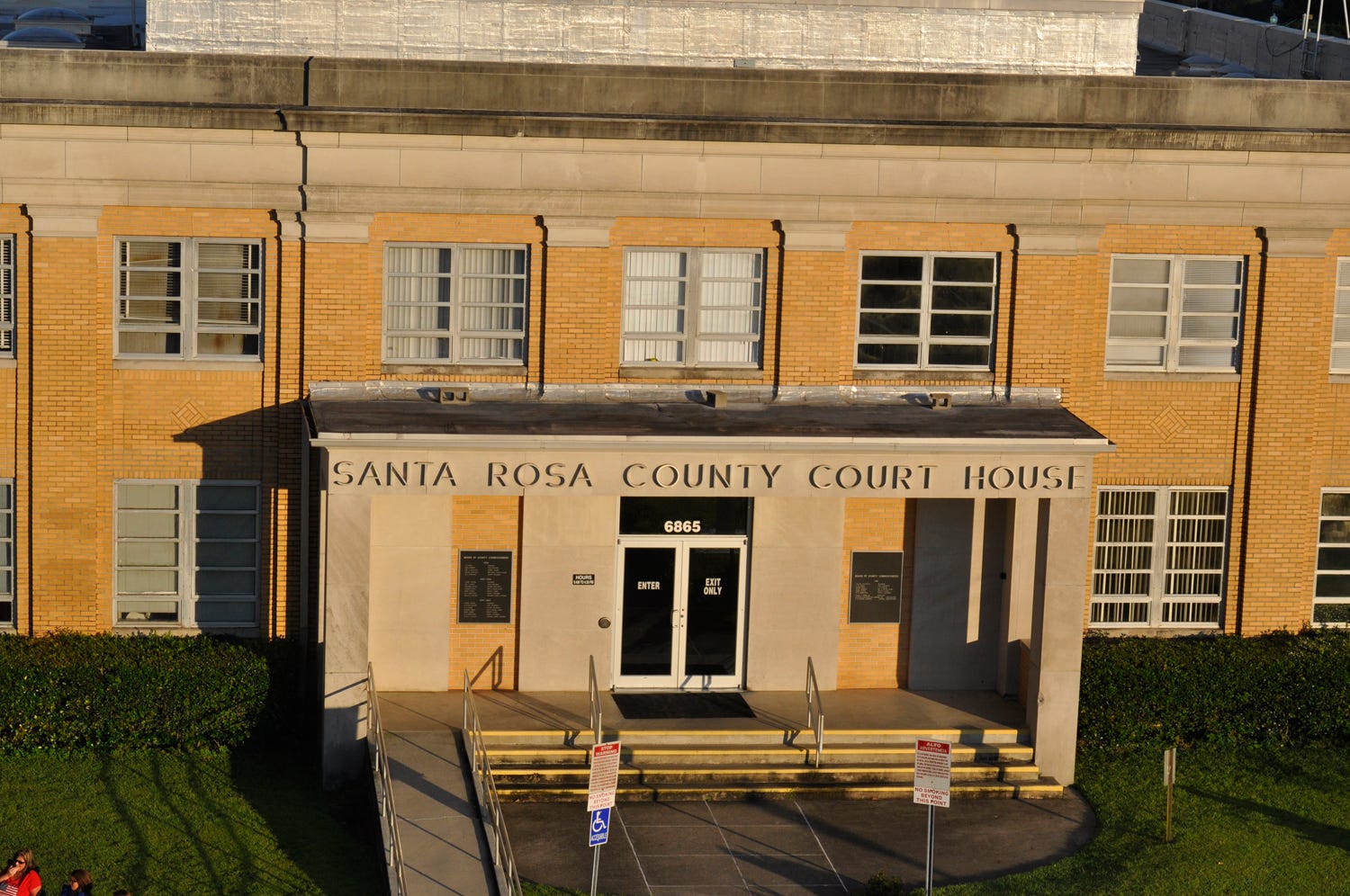

With the failure of the ballot referendum to raise a 1-cent sales tax for a new courthouse, the Santa Rosa County Board of County Commissioners goes back to the drawing board. While the method to pay for a new judicial center may have failed, a majority surfaced for its location. Milton leadership believes the question of where to put a new courthouse has been answered: downtown Milton.
Reaction
Both Commissioners Bob Cole and Don Salter said they were surprised the tax did not pass. Commissioners Lynchard and Williamson said they were not shocked and like Salter, figured it would be close. They all expressed disappointment in the measure’s failure. Williamson said, “I remember campaigning with my dad the first time he ran in 1996 and people asking him, ‘What are we going to do about a new courthouse?’ Eighteen years later the question still begs to be answered.”
Reason
In 2002, the county voted on a sales tax to fund the construction of a new courthouse, renovate the existing one, and expand the South End Annex. A fuel tax for road improvements was also on the ballot, though unconnected. The courthouse failed then 3 to 1 against. This year, voters had to consider various sites as part of the election. Salter said he thought the confusion over the multiple sites was what killed the tax. However, Cole said he still feels good putting all three locations on the ballot. “I did my job putting them on [the ballot],” he said. Williamson agreed with Salter saying the three sites shifted focus from the need for the courthouse and the sales tax to the site location.
Matthew Hargraves, head of the city of Milton’s Courthouse Committee charged with keeping the courthouse downtown, said the process likely killed the tax. He said the locations should be cut down to one before another election, but said two issues with the Pea Ridge site likely turned voters off: Milton Crossings LLC getting involved and the cost per acre being 6 times the market value.
Readers may remember Charter Bank was the first entity involved with the property. Then Milton Crossings appeared as an agent to buy the whole Pea Ridge property from Charter Bank and sell to the county the land it needed.
To the market value of the site, Hargraves said the $10,000 amount came from looking at a similar purchase by the school board last year of 40 acres a mile from the Pea Ridge site. He said the school board paid about $10,000 per acre while the county would have paid about $63,000 per acre.
Funding
Hargraves, and the commissioners agreed the sales tax was the best method to pay for the courthouse. Lynchard said it was the fairest option while Salter added the sales tax was the only practical way to cover a project of this magnitude within a reasonable amount of time. Hargraves also said it is the sole method of accruing funds from non-county residents.
Salter said he heard complaints of the county not setting aside funds for the courthouse but with the recent recession, he said the county’s budget lost 2.5 to 3 million dollars a year from 2009 to 2012. “For four years we lost approximately $12 million,” he said. Lynchard said during the mid 2000s the county had 25 percent fewer employees and so the BOCC cut expenses to deal with the revenue shortfall. At the same time, he said, property tax revenue was down 25 percent as well. Salter dismissed the idea of saving for the courthouse altogether citing millage rates dropping from 6.9 to 6.0, where it remains, from 2000 to 2005. “Our philosophy has been when times are good we give back the taxpayers a portion of their millage instead of trying to save.”
Williamson disagreed on saving. He said, “I plan on meeting with the budget director and seeing if we can find any type reoccurring savings in our budget that can be allocated for the future courthouse. Santa Rosa County does a lot with a little so there may not be funds available, but any amount of money we can save would help the public realize we are taking this issue seriously.”
Going forward, Cole said, “Property taxes are not on the table as far as I’m concerned,” and said he would look to the state legislature and governor for some kind of financial assistance like a 50 percent match. Salter said during an end of the year reorganization of the board, he wants the BOCC to have an in depth workshop to not only look at the courthouse again but also drainage, storm water, and beach renourishment issues.
Design
Looking at the design itself as a possible means to reduce cost, Cole and Salter differed. While Cole was less specific, saying the county could take another look at the total cost of the project, Salter said, “The HOK design was very moderate with current prices. If we had not gone with that plan, we’d still be in the building rental business.” He said if the design were to be scaled back, it would have defeated the original purpose.
Downtown Milton
All three locations for the courthouse on the ballot received overwhelming negative results. Of the “yes” votes, downtown Milton received 17,437 votes followed by 13,462 for East Milton and 10,759 for the Pea Ridge location, according to the supervisor of elections results.
Cole was ambivalent of making the downtown Milton location the final home saying other options may present themselves in the future. Williamson said Milton’s vote counts to carry some weight. “How much, I don’t know right now, but it is something definitely fresh on my mind,” he said. However, Lynchard said he would continue with the board’s direction of following the county’s majority decision.
Milton Mayor Wes Meiss said, “The people have spoken. It’s up to the county to go back and figure out how to fund the courthouse. The where question has been decided. Now it’s a question of how.” Hargraves said, “What you cannot deny is downtown was the leading vote getter.” While still looking at individual precinct results, Hargraves said he noticed a pattern emerging of precincts not only voting more for downtown than the other two locations but doing so by close to or more than 50 percent. “It shows an actual majority rather than a plurality.” Hargraves also noted the 2002 failure was a much wider margin than this year’s, which he said shows momentum in favor of the tax, but a failure in procedure.
Special Election
Cole said the board may have to hold a special election for the courthouse if a more palatable solution presents itself down the road. Hargraves said special elections have happened in the past such as the 2007 renewal of the half-cent sales tax to finance educational facilities. At the time, it won with 77 percent of the vote. Not one precinct voted against it according to the results posted at the Supervisor of Elections website. However, Commissioner Jayer Williamson said, "I would not support a special election because I believe it is a waste of taxpayer's dollars. I believe the presidential preference primary would be the first part of 2016. I could support the referendum being voted on during that election since ballots would be printed and polls would be open anyway." According to Supervisor of Elections, Tappie Villane, a special election held as soon as possible would cost, at current available rates, $146,850.
Warnings
With the fate of the courthouse again unknown, county and city officials expressed concern over what could happen. Salter reiterated what he said before the election, the probability of prices for the project increasing by a million dollars every year.
Hargraves said future county citizens may be paying higher prices for the project but also possible lawsuit damages. He said, “There are two sets of risks. One set is that due to the nature of the building itself, there are risks of injury and lawsuit due to slip and fall or a disability complaint in the bathroom. The more significant risk in my opinion is some type of incident occurring in between inmates and either members of the public or staff and lawyers, people who work at the courthouse. Due to the nature of the building, you can’t have true segregation of the inmates from everybody else. They walk the same halls and while they’re typically shackled, there is still a risk of someone breaking free, flipping out, and injuring staff, attorneys, or members of the public.”
Santa Rosa County citizens already received a bill for $800,000 according to Sarah Whitfield, county public information officer. The Press Gazette reported in 2011 Debra Owens sued the county after she fell from her wheelchair attempting to go up the ramp at the courthouse in 2007. Owens claimed a dip in the ramp caused her to tip over later resulting in the amputation of one of her legs. Along with the settlement, the court case ruled the county must make improvements on its current wheelchair ramp.
Lynchard said the courthouse is still not fully ADA compliant and so the state may step in and require the county take action. Williamson and Hargraves also expressed concern over state mandate. Whitfield said at the time of Owen’s case, the county was not required to bring the whole building up to ADA compliance. While ADA remodeling is not the same as building an entire judicial center, Lynchard said remodeling the current structure for compliance is not feasible. Hargraves said, “The longer Santa Rosa County delays the construction of a new courthouse, the greater the fiscal risk to the citizens and the greater the physical risk to the citizens.”
This article originally appeared on Santa Rosa Press Gazette: Courthouse tax failure has Santa Rosa County officials regrouping