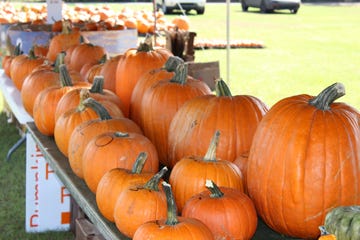

The orange round decorative fall melon named a pumpkin originated from the Greek word pepon.
However, the early, tasty pumpkins were not the traditional round orange upright Jack-O-Lantern fruit that we commonly refer to today. They were a crooked variety that stored well. “The original pumpkins were used for stock feed,” shared Stan Whitfield. “They were easy to keep as well as easy to stockpile.”
Whitfield who has planted, harvested and sold pumpkins for over twenty years is an informative resource on the use and benefits of pumpkins. For over 40 years he has also grown watermelons and cantaloupes to sell to the public.
Whitfield, whose family has farmed in Santa Rosa County since 1908, resides north of Milton in the Whitfield Community. Area newspapers along with television media have often relied on Whitfield’s experience and knowledge about the fruit. “I experimented with numerous varieties. By trail and error probably 30 to 40 different varieties before I made the decision to stop planting them last season.”
When he speaks of his years of pumpkin production he reflects on his determination to provide a quality product in a geographical area where the weather is not agreeable to production.
“Pumpkins are not a southern crop. It is to hot and humid here to continually produce profitable crops,” he continued.
Pumpkins fill a very different need today than they did in the early days.
Native Americans relied on pumpkins to make it through the long winters. They roasted pumpkin strips over the campfire and used them as a food source. The sweet flesh could be roasted, baked, parched, boiled and dried. The seeds from the pumpkin were used in medicines as well as a nutritional source.
The plant blossoms were added to stew. Dried pumpkin could be kept and ground into flour. No part of the pumpkin was wasted even the shell was put to use. They dried the shells and used them as bowls and containers to store grain, beans and seeds.
Today in America the pumpkin’s nutritional value is not needed as it was by the early settlers. We traditionally grow pumpkins suitable for seasonal decorating and carving Jack-O-Lanterns. The appearance of the popular pumpkin of today is large in size, upright strong walls, and most importantly has a large hollow cavity.
“Pumpkins are planted in the month of July so that they are ready to be used by Halloween,” Whitfield said. “If you plant them any earlier they will rot and not be useable for the season.”
Whitfield’s decision to stop planting pumpkins is based on several factors including the difficulty of growing a quality product that consumers have a desire for. The consumer’s demand from the area farmer has also changed drastically. Families can easily purchase the fruit from local curb markets, grocery stores and even corn mazes where a family may visit for a fun fall afternoon and purchase their pumpkin to create a Jack-O-Lantern.
“Today very few people cook with actual pumpkins,” he continued. “It is very easy to use canned pumpkin for pies and other treats.” Canned pumpkin is considered a fall baking staple. It is used in everything from traditional pies to pumpkin pancakes. It provides a consistent in its flavor, thickness, and texture and is readily available in the grocery store. It is also relatively inexpensive.
Recipes usually refer to pumpkin puree with the expectation that you will be using canned pumpkin. Fresh pumpkin puree does require a bit of work and creativity, but many traditional bakers agree that if the right spices are added along with brown sugar the end favorable product beats the canned variety hands down as well as provides a rewarding experience.
Traditional Pumpkin Pie
Ingredients
recipe Pastry for Single-Crust Pie(see below)
1-15 ounce can pumpkin
2/3-cup sugar
1-teaspoon ground cinnamon
½ teaspoon ground ginger
1/2-teaspoon ground nutmeg
3 slightly beaten eggs
1-5 ounce can (2/3 cup) evaporated milk
½ cup milk
Directions
1. Prepare and roll out Pastry for Single-Crust Pie. Line a 9-inch pie plate with the pastry. Trim to 1/2 inch beyond edge of pie plate. Fold under extra pastry; crimp edgeas desired.
2. For filling, in a mixing bowlcombine pumpkin, sugar, cinnamon, ginger, and nutmeg. Add eggs. Beat lightly with a rotary beater or fork just until combined. Gradually stir in evaporated milk and milk; mix well.
3. Place the pastry-lined pie plate on the oven rack. Carefully pour filling into pastry shell.
To prevent overbrowning, cover edge of the pie with foil. Bake in a 375 degree F oven for 25 minutes. Remove foil. Bake about 25 minutes more or until a knife inserted near the center comes out clean. Cool on a wire rack. Refrigerate within 2 hours; cover for longer storage. Makes 8 servings.
Pastry for Single-Crust Pie
Ingredients
1 ¼ cups all-purpose flour
¼ teaspoon salt
1/3 cup shortening
4 tablespoons cold water
Directions
Stir together flour and salt. Using a pastry blendercut in shortening until pieces are pea-size. Sprinkle 1 tablespoon of the water over part of the mixture; gently toss with a fork. Push moistened dough to side of the bowl. Repeat moistening dough, using 1 tablespoon of the water at a time, until all the dough is moistened. Form dough into a ball. On a lightly floured surface, use your hands to slightly flatten dough.
Roll dough from center to edge into a circle about 12 inches in diameter.
NO BAKE PUMPKIN PIE (fun and easy for children)
INDIVIDUAL RECIPE
Small custard-sized ready to eat pie crusts
2 tablespoons canned pumpkin
1-tablespoon marshmallow crème
1-tablespoon prepared whipped toping
sprinkle of cinnamon
Mix all ingredients together and pour into the crust. The recipe is then ready to eat: it may be refrigerated or frozen.
Pumpkin facts for children:
· Pumpkins are usually orange but can sometimes be yellow, white, green or red.
· Over 1 billion pounds (450 million kgs) of pumpkin are produced in the United States every year
· Pumpkins have thick shells, which contain pulp and seeds.
· Scientifically speaking, pumpkins are a fruit, they contain seeds. But when it comes to cooking they are often referred to as vegetables.
This article originally appeared on Santa Rosa Press Gazette: July pumpkin sowing happening now for fall harvest